Java 26 has just been released! (depending on your timezone), but work on Java 27 is already on the way. The first JEP of the new release is JEP 527: Post-Quantum Hybrid Key Exchange for TLS 1.3.
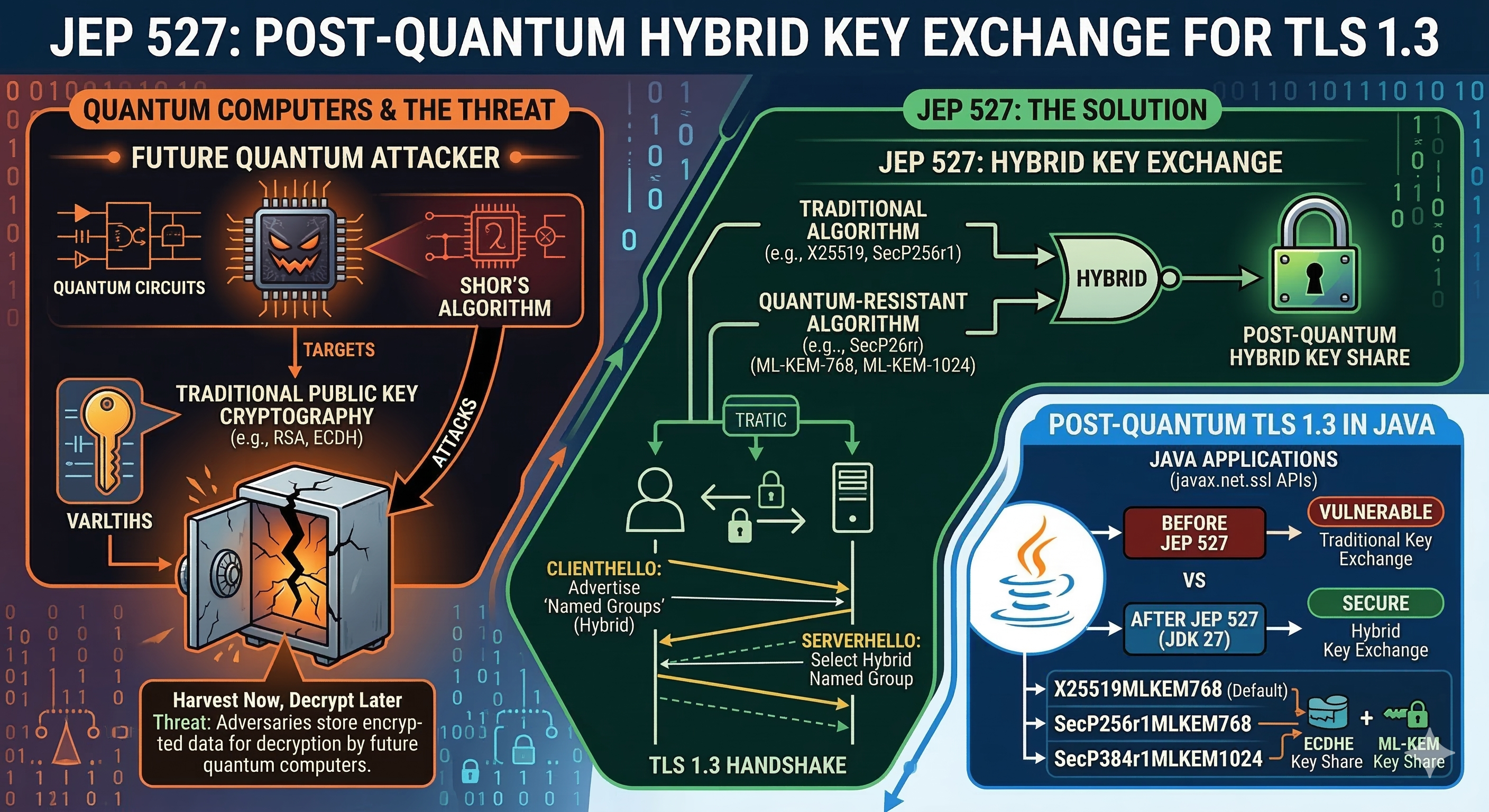
JEP 527 (Post-Quantum Hybrid Key Exchange for TLS 1.3) is a Java enhancement designed to protect your internet communications from future quantum computers.
Here is the breakdown in easy terms:
1. The Problem: “Harvest Now, Decrypt Later”
Today, when you connect to a website (using HTTPS/TLS), the “key exchange” that secures your connection uses math (RSA or Elliptic Curve) that is very strong for current computers but could be cracked by a powerful quantum computer in the future.
Even though these quantum computers don’t fully exist yet, hackers can record (“harvest”) your encrypted data today and just wait until a quantum computer is built to read it. This is the “Harvest Now, Decrypt Later” threat.
2. The Solution: A “Hybrid” Guard
JEP 527 introduces a Hybrid approach. Instead of just using one lock, Java will now use two:
- The Traditional Lock: The classic, proven math we use today (like Elliptic Curve).
- The Quantum-Resistant Lock: A new type of math (specifically an algorithm called ML-KEM) that is designed to be impossible for even quantum computers to crack.
By combining them, your data stays safe as long as at least one of these locks remains uncracked. It’s like putting a new high-tech electronic lock on your door but keeping the old physical deadbolt too—just in case.
3. How it affects you
- Automatic Protection: If you use Java’s standard networking libraries (
javax.net.ssl), this happens automatically in the background. You don’t have to rewrite your code to get this extra security. - Performance: The primary hybrid scheme being added (
X25519MLKEM768) is designed to be very fast, so you shouldn’t notice your apps slowing down. - Coming Soon: This is targeted for JDK 27 (early access is starting now), making Java one of the first major platforms to turn this on by default for everyone.
JEP 527 is essentially the “finished product” or the “grand finale” of a series of updates that Java has been rolling out over the last few years.
To understand where JEP 527 fits, you can think of the previous JEPs as building the parts of a new security system, while JEP 527 is the one that actually plugs it in and turns it on for the whole internet.
Here is the timeline of how they relate:
1. The Foundation: JEP 452 & JEP 478 (Building the Tools)
Before Java could use quantum-safe security, it needed a general way to handle modern “encryption envelopes.”
JEP 452 (Key Encapsulation Mechanism API) and JEP 478 (Key Derivation Function API) were technical updates that gave Java the basic “vocabulary” to understand the new types of math required for quantum security.
Analogy: These updates were like adding a new specialized toolbox to a workshop so that the mechanics could eventually work on electric cars.
2. The Math: JEP 496 & JEP 497 (Adding the Algorithms)
In Java 24, the actual “quantum-proof” math was added to the platform.
JEP 496 added ML-KEM (the math for locking/unlocking data).
JEP 497 added ML-DSA (the math for digital signatures, like checking an ID).
The Catch: These were just the “raw math.” A developer would have to manually write code to use them, which is complicated and prone to mistakes.
3. The Big Step: JEP 527 (Making it the Standard)
JEP 527 takes that raw math from the previous JEPs and integrates it into TLS 1.3 (the protocol that runs almost all secure internet traffic).
Automatic Security: Instead of making every developer figure out how to use quantum math, JEP 527 builds it directly into the standard connection process.
The “Hybrid” Twist: It specifically uses the “Hybrid” approach mentioned earlier. It doesn’t throw away the old security (which we know works against today’s hackers); it layers the new quantum-safe math on top of it.
Summary
JEP 527 is Java’s “future-proofing” update. It ensures that the private data your Java apps send over the internet today can’t be read by the supercomputers of tomorrow.