Java’s Vector API: The Marathon Continues (JEP 529)
The Vector API is a new addition to the Java standard library that allows you to perform vector operations on arrays in a single CPU cycle.
If there were a Guinness World Record for the “Longest Incubating Feature in Java History,” the Vector API would be holding the trophy.
With the arrival of JEP 529, the Vector API is entering its 11th round of incubation in JDK 26.
But why is it taking so long, and why should you care? Let’s break it down.
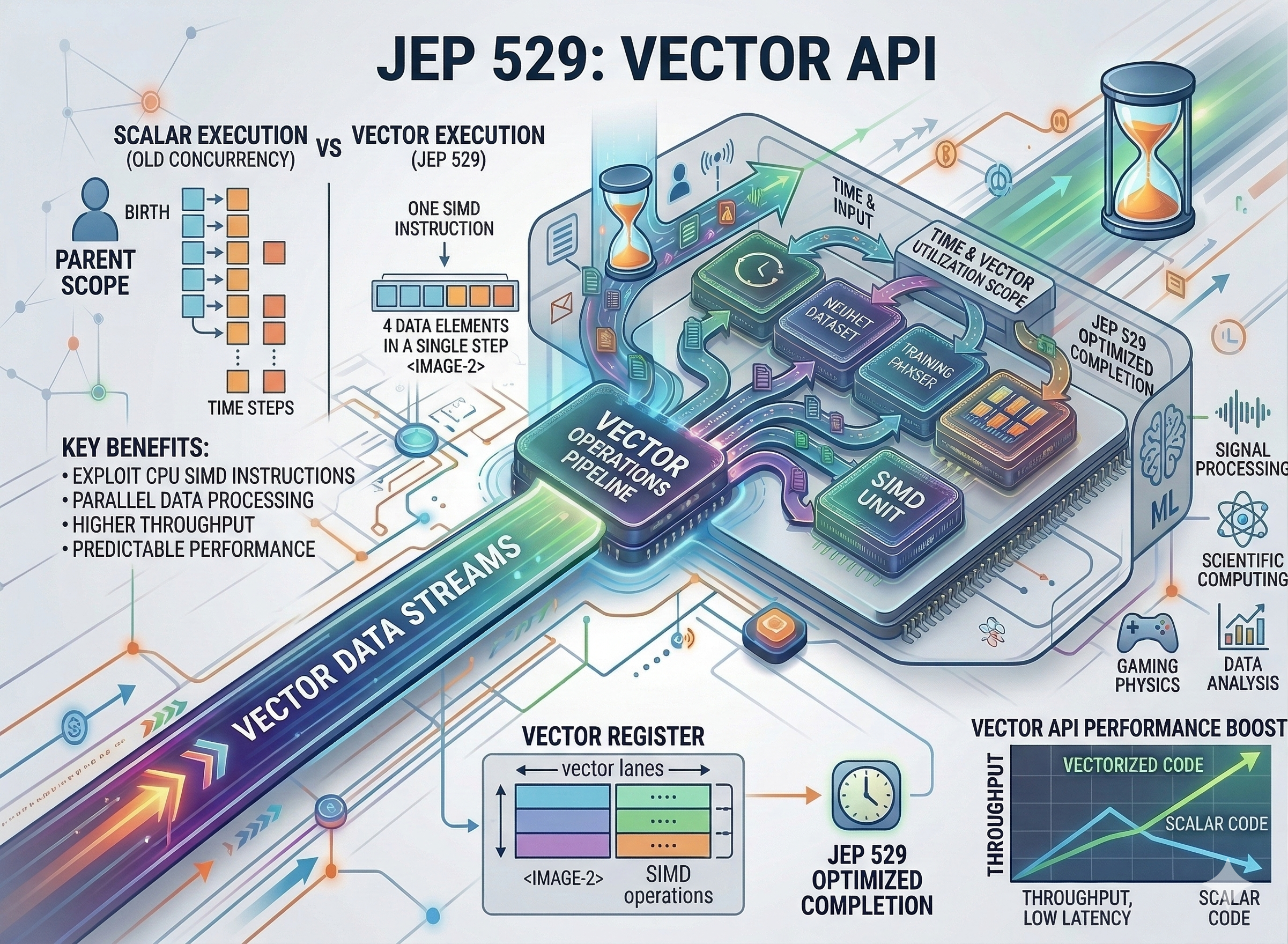
What is the Vector API? (The “Explain Like I’m 5” Version) Imagine you’re a cashier at a grocery store. Normally, you scan one item at a time: pick up a can of beans, beep, put it down. Pick up a loaf of bread, beep, put it down. This is how standard “scalar” Java code works—it processes one piece of data at a time.
Now, imagine you suddenly grew eight arms. You could grab eight cans of beans, scan them all in one giant “BEEP,” and bag them simultaneously.
That is SIMD (Single Instruction, Multiple Data), and that is what the Vector API does. It allows your Java code to talk directly to those “multi-arm” features in modern CPUs (like AVX or NEON). Instead of looping through an array and adding numbers one by one, you can add chunks of 4, 8, or 16 numbers in a single CPU cycle.
The result? Massive speed boosts for things like machine learning, image processing, or heavy-duty math—all without leaving the comfort of the Java ecosystem.
What’s New in JEP 529?
If you’ve been following the previous 10 incarnations of this API, you might be wondering: “What changed this time?”
The short answer: Not much on the surface, but everything under the hood.
Waiting for Valhalla:
The main reason the Vector API is still in “incubation” (and not a permanent part of Java yet) is that it’s waiting for Project Valhalla.
Valhalla is a massive project that will change how Java handles objects in memory (introducing “Value Classes”).
The Vector API needs those changes to be truly efficient.
JEP 529 basically keeps the lights on and the API polished while Valhalla finishes its work.
Stability is the Name of the Game:
While there aren’t many flashy new methods in this version, the focus is on “reliable compilation.”
The goal is to ensure that when you write a vector operation, the Java compiler (C2) guarantees it will turn into those high-speed CPU instructions every single time, across different types of hardware (x64, AArch64, etc.).
Refining the “Eleven”:
This JEP is essentially a re-incubation.
It incorporates minor bug fixes and performance tweaks discovered in JDK 25, ensuring that the API stays fresh and compatible with the latest JVM internals.
Why You Should Use It
Even though it’s still an “incubator” module (meaning you have to use the –add-modules jdk.incubator.vector flag), it is incredibly stable.
Companies like Netflix are already using it to speed up their recommendation engines.
If you’re doing any kind of heavy data crunching, the Vector API is your ticket to “C-like” performance while staying in the safe, cozy world of Java.
The Bottom Line JEP 529 isn’t a revolution; it’s a refinement. It proves that the OpenJDK team is committed to getting this right rather than getting it done fast. We’re one step closer to having “super-powers” built into the Java standard library.