Get new articles in your inbox
Claude Code custom commands

Claude Code - part 5: Custom Commands, Automate Your Own Workflow

Every team has its boilerplate. At clients, every new REST controller we write follows the same shape: a @RestController with a @RequestMapping, constructor injection (never field injection), a @Slf4j logger, ResponseEntity return types, proper HTTP status codes, and a matching service interface already wired in. Oh, and Lombok. Always Lombok. The first few times I asked Claude Code to generate a controller, I typed all of that out. Every time. A paragraph of instructions just to get the scaffolding right before the interesting work could begin. ...
June 24, 2026 · 15 min
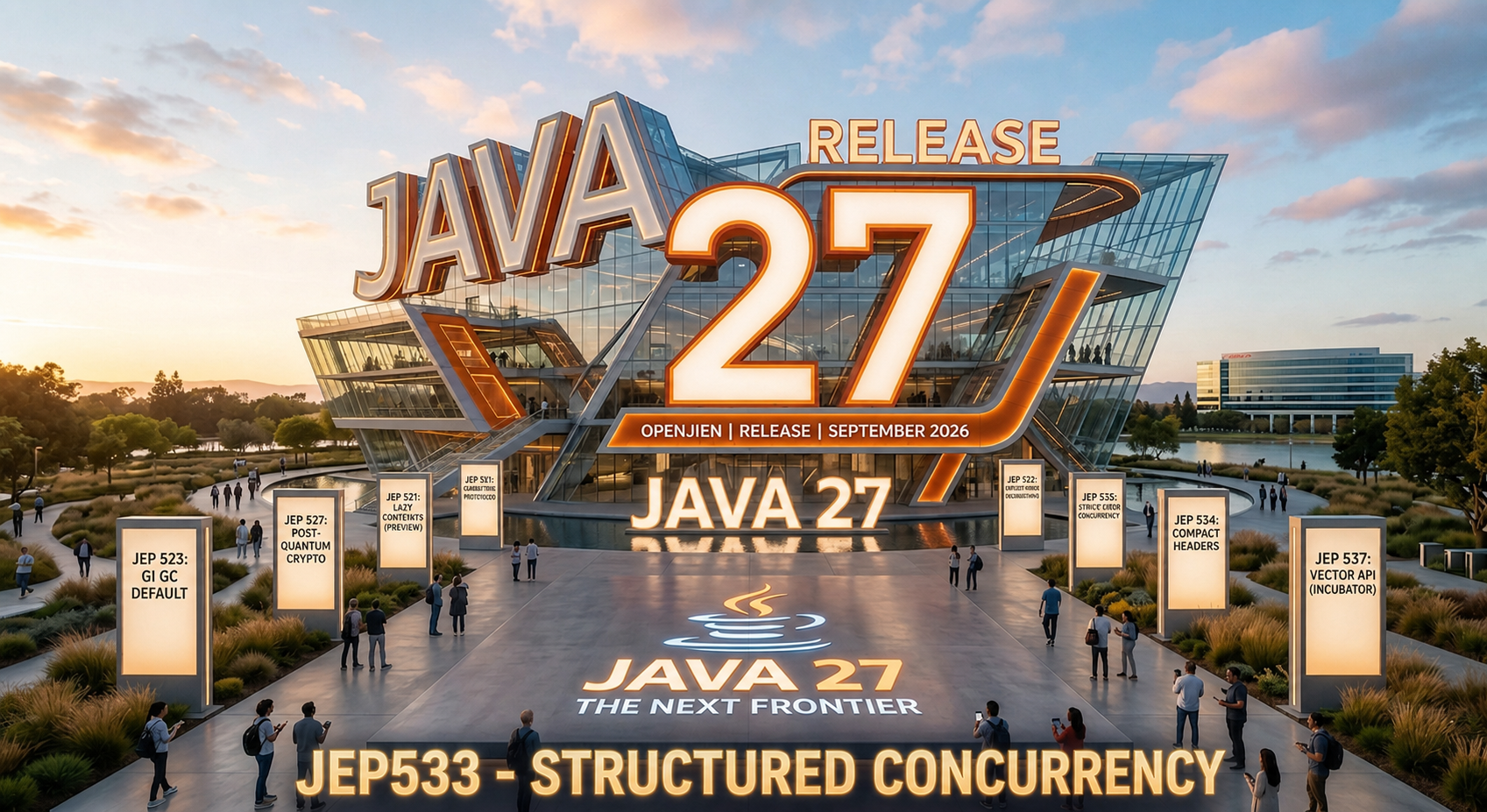
Structured Concurrency in JDK 27

JEP 533 - Structured Concurrency Gets Sharper in JDK 27

If you’ve been following the evolution of Project Loom, you’ll know that Structured Concurrency has been on quite a journey. It started as an incubator module in JDK 19, became a preview API in JDK 21, and has now re-previewed five more times since — JDK 22, 23, 24, 25, and 26. JEP 533 is the seventh preview, targeting JDK 27, and this time the changes are meaningful enough that it’s worth taking a proper look. ...

June 23, 2026 · 9 min
Spring AI Series: Spring AI ChatClient

Spring AI Series: 3-ChatClient

Somewhere in articles 1 and 2, I kept writing this line and asking you to take it on faith: java chatClient.prompt().user(question).call().content(); It works. It reads nicely. And if you’re anything like me, the fact that it works without you understanding why has been quietly bothering you since article 1. Today we fix that. This article takes ChatClient apart — every method in that chain, every configuration option that matters, and the parts of the API we haven’t even touched yet. By the end, the fluent API won’t be a magic incantation anymore. It’ll just be… an API. A well-designed one, but still. ...

June 19, 2026 · 17 min
Claude Code slash commands

Claude Code - part 4: Slash Commands

It was a Friday afternoon and I was in the middle of a long debugging session. I had been going back and forth with Claude Code for maybe forty minutes — adding context, correcting assumptions, exploring three different theories about why a JMS listener was silently dropping messages. The session was getting noisy. Old context from theories I’d already ruled out was still sitting there, cluttering the conversation. I didn’t know about /compact yet. ...

June 17, 2026 · 11 min
Primitive Types in Patterns

Java 27 - part 4: JEP 532 - Primitive Types in Patterns

Same Feature, Fifth Time Around If you read my JEP 530 post at the tail end of the Java 26 series, this one is going to feel familiar. Very familiar. JEP 532 is the fifth preview of “Primitive Types in Patterns, instanceof, and switch”, now targeting JDK 27. And here’s the honest headline: nothing has changed. No new syntax, no removed methods, no behavioural tweaks. The JDK team looked at JEP 530, decided it was in good shape, and re-proposed it as-is to bake for another release cycle. ...

June 15, 2026 · 5 min
Spring AI Series: Introduction to Spring AI

Spring AI Series: 2-Setup Spring AI

Intro In the previous article, we ran a Spring AI application in about twenty lines of Java. It worked. A ChatClient appeared out of nowhere, we called .prompt().user(...).call().content(), and Claude answered. That’s the magic of Spring Boot autoconfiguration — and also the danger of it. When things work without explanation, you’re fine right up until you need to debug something, customise something, or explain to a colleague what exactly is happening. Then you’re stuck. I’ve been there more times than I care to admit — staring at a NoSuchBeanDefinitionException at 4pm on a Friday, completely unable to explain why a bean that “should just be there” isn’t. (It was a missing property. It’s always a missing property.) ...

June 12, 2026 · 14 min
Spring AI Series: Introduction to Spring AI

Spring AI Series: 1-Introduction to Spring AI

I still remember the moment it clicked — and the much longer stretch before it did. I’d been building Spring Boot applications for years. I knew the ecosystem. I knew how to wire beans, configure starters, and navigate the autoconfiguration magic without panicking. Then I started exploring Spring AI, and suddenly I was lost again. Embeddings. Vector stores. RAG pipelines. Advisors. ChatClient vs ChatModel. A wall of new terminology that felt completely disconnected from everything I already knew. ...

June 6, 2026 · 7 min
Lazy Constants

Java 27 - part 3: JEP 531 - Lazy Constants, Round Three

Third Time’s the Charm: Lazy Constants Get a Trim and a New Trick Back in the Java 26 series, I walked you through JEP 526 and the (then) second preview of the Lazy Constants API. If you missed it, the short version is this: Java finally got a clean way to do deferred immutability — fields that initialize on demand but, once set, are treated by the JVM as if they’d been hard-coded constants. No more double-checked locking. No more holder idioms. Just LazyConstant.of(...) and a .get(). ...

May 27, 2026 · 4 min
Using skills with Claude Code

Claude Code - 03 - Skills

Claude Code — Teaching It Your Standards with Skills In Part 2, we turned CLAUDE.md into a precision instrument. We wrote down our conventions, our architecture, our rules — and watched Claude Code go from producing generic boilerplate to code that could survive a code review. But here’s the thing I noticed after a few weeks of working this way: my CLAUDE.md was getting fat. It started small. Build commands, naming conventions, a few architecture rules. Then I added a section on how to generate a complete REST slice. Then testing patterns. Then a procedure for running database migrations with Flyway. Before I knew it, the file was 300 lines long, and every single line was loaded into every single session — whether Claude needed it or not. ...

May 22, 2026 · 24 min
Structured Concurrency

Java 27 - part 1: JEP 523 - G1 Becomes the Default Everywhere

G1 Garbge Collector, Always. If you’ve ever wondered which garbage collector the JVM actually picked for you when you didn’t tell it which one to use, the answer was always a little annoying: “well, it depends.” That “it depends” is exactly what JEP 523, targeting JDK 27, gets rid of. From now on, when you don’t specify a collector on the command line, the JVM always picks G1. No exceptions, no hardware-dependent surprises. Let me walk you through what’s changing and — more importantly — whether you should care. ...

May 22, 2026 · 5 min